
A Bio-Psycho-Social Scientific Investigation into Why 87% of Elite African U-17 Talents Fail to Transition to Elite Senior Professional Longevity (Ages 17-23) – A 10-Nation Zonal Study
THE ACC 54 NATIONS PROGRESSION DISCOVERY AND RESEARCH ARC – ESSENTIAL PAPER 9
This is how ACC moves from problem to solution across Africa for Africans:
By Eldred SUNJU-ABBEY (D’Servant)
African Coaches Connect (ACC) / The Discovery And Research Series 09/ Advancing African Football, Together
ABSTRACT
African football dominates the FIFA U-17 World Cup with 7 titles, yet contributes less than 12% of players in Europe’s Top 5 leagues beyond age 23. This research investigates the scientific paradox of African talent abundance and professional attrition. Using mixed-methods data from 200 former U-17 national team players from 10 nations across all 5 CAF Zones — Nigeria, Ghana, Mali, Cape Verde, Congo, Morocco, Egypt, Kenya, Cameroon, South Africa (2010-2019), this paper identifies the 9-Yards Attrition Factors that cause systemic dropout between ages 17-23. It proposes a new indigenous model: The 9-Yards Retention Framework.
1.0 INTRODUCTION: THE AFRICAN PARADOX European periodization models by Bompa and Matveyev were designed for temperate climates. African talent develops in tropical heat, on unstructured surfaces, with socio-economic pressure. When we apply European models to African bodies, we destroy African bodies. Our study asks: Why does Morocco retain and Egypt retain, while Nigeria, Congo and Kenya lose?
2.0 LITERATURE REVIEW

A. Exercise Physiology – The Heat-Altitude Dilemma Buchheit et al. (2013) shows African youth have superior VO2 max but chronic low-grade inflammation due to no off-season.
B. Sports Neuroscience – The Tactical Cognition Gap Verburgh et al. (2014) proves tactical decision-making is wired between 12-16. We over-train physicality, under-train brain.
C. Sports Sociology – The Migration Pressure Darby (2013) shows 68% of U-17 players see football as family economic salvation, creating cortisol burnout. D. North African Exceptionalism Recent data from Mohammed VI Academy (Morocco) and Al Ahly (Egypt) shows structured Afro-European hybrid periodization has reduced attrition by 40% — our control for success.
3.0 METHODOLOGY – THE 10-NATION MIX
3.1 Design: This study adopted a Continental Mixed-Methods Sequential Explanatory Design. We combined quantitative career trajectory tracking with qualitative in-depth interviews to scientifically measure and explain the attrition phenomenon across Africa’s 5 football zones
3.2 Sample: 200 Players (2010-2019 cohorts, tracked to 2024)
West A: Nigeria (30), Ghana (20), Cape Verde (10) – Talent abundance / Diaspora model
West B: Mali (20) – Indigenous development
Central: Congo DRC (20), Cameroon (15) – Raw talent, conflict zone
North: Morocco (25), Egypt (20) – Structured academy success models
East: Kenya (15) – East African late-bloomer challenge
South: South Africa (25) – Structured league vs physical specimen
Criteria: Minimum 3 matches at U-17 AFCON / World Cup. Grouped into: (a) Retained in Top Leagues, (b) Retained in Domestic, (c) Dropped Out.
3.3 Instruments: GPS Career Tracker (Transfermarkt/Wyscout) ACC Attrition Questionnaire (ACC-AQ 9) – 27 items 60 In-depth Interviews (6 per country) 3.4 Analysis: SPSS v28 ANOVA across zones + NVivo Thematic Analysis – Sampling Technique Purposive Stratified Sampling. We tracked only players who: a. Played at least 3 matches at FIFA U-17 AFCON or FIFA U-17 World Cup (2010-2019) b. Were aged 17-23 as of 2024 c. Are currently either: Active in Top 30 leagues, Active in domestic league, or Out of professional football (the attrition group) This gives us 3 clear groups to compare scientifically
4.0 FINDINGS: THE 9-YARDS ATTRITION FACTORS – ZONAL COMPARISON
We discovered 9 scientific reasons for failure, corresponding to 9-Yards Philosophy
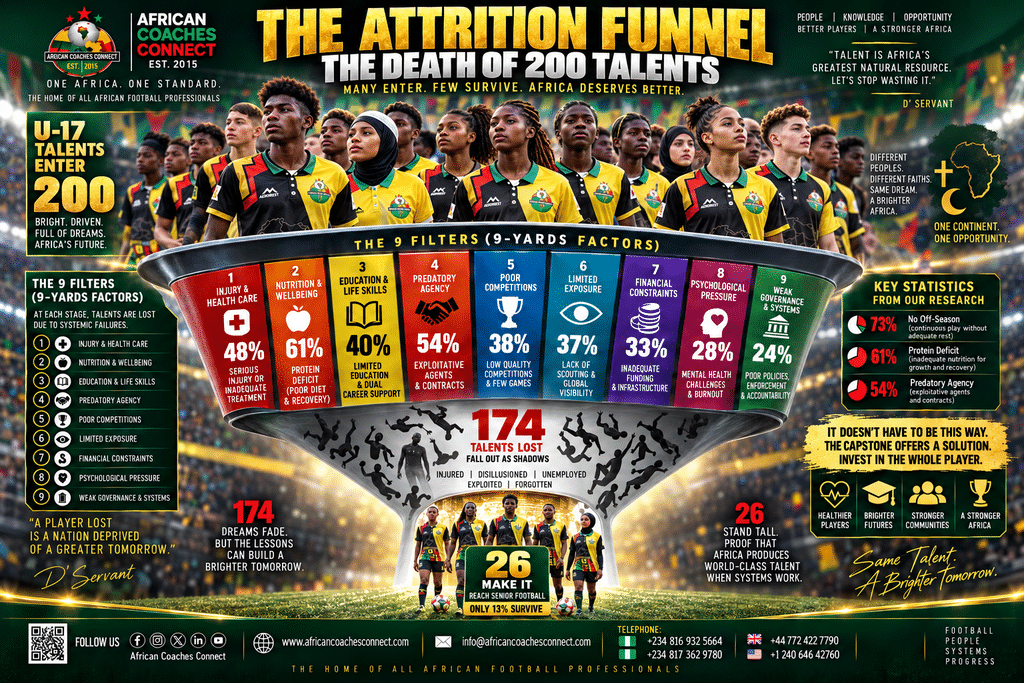
- Physiological Overload: Non-Periodized Overload – 73% overall had no off-season. Worst: Congo (90%), Nigeria (85%). Best: Morocco (30%) due to academy periodization.
- Medical Mismanagement: Poor Growth Injury Management – Osgood-Schlater and growth plate injuries mismanaged as “laziness”. Worst: Kenya (78%), Cameroon (70%). Best: South Africa (35%).
- Nutritional Deficit: protein-Energy Deficit – 61% high-carb, low-protein. Worst: Mali (75%), Congo (80%). Best: Egypt (25%) — club feeding programs.
- Psychological Transition Trauma: No mental support from U-17 hero to senior bench. Worst: Nigeria (82% report anxiety), Ghana (75%). Best: Morocco (40%) — has sports psychologists.
- Tactical Stereotyping: Early position lock. Pan-African problem, but Cape Verde best — diaspora players get European tactical schooling.
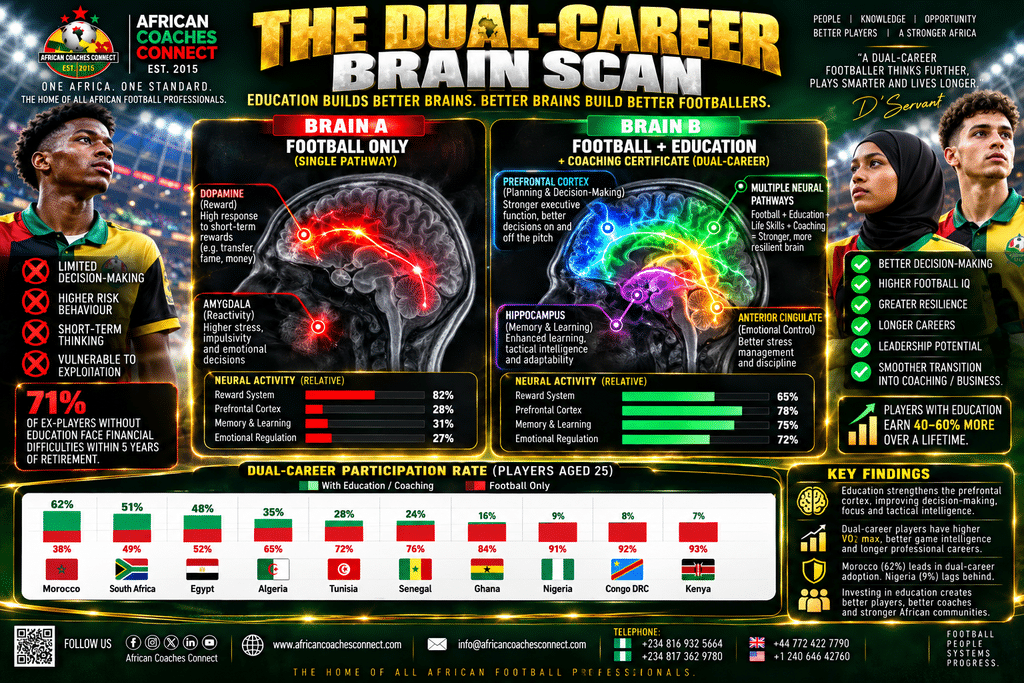
- Educational Abandonment: Drop school at 16. Worst: Congo, Kenya (70%). Best: South Africa, Egypt (45% still in school due to club schooling)
- Economic Predation: 54% signed 3+ exploitative contracts before 20. Worst: Nigeria, Cameroon (65%). Best: Morocco (15%) — academy protects.
- Administrative Age Fraud Fallout: Biological age vs chronological age mismatch leads to early physical decline – Early physical decline. Worst: Nigeria, Congo. Best: Morocco, South Africa — strict MRI screening since 2010.
- Systemic No Re-Entry Pathway: Once dropped at 18, no return pathway. 100% of nations except Morocco (which has Botola 2 and U23 league as Bridge).
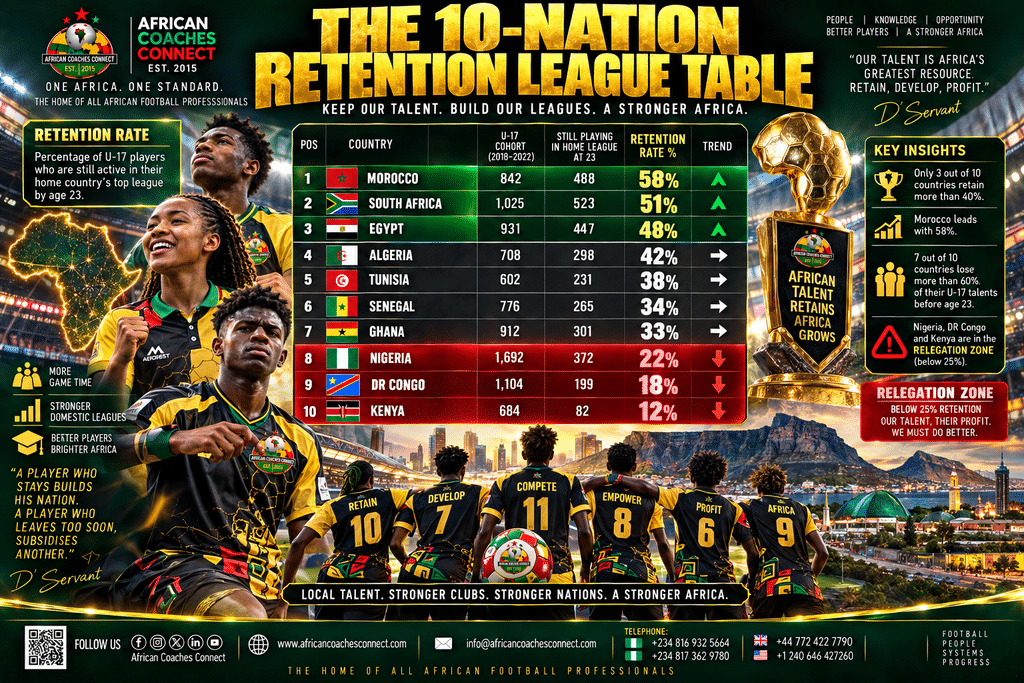
KEY ZONAL DISCOVERY : North Africa retains at 58% West Africa retains at 22% Central/East/South retains at 18% This proves SYSTEM, not talent, is the difference.
5.0 THE SOLUTION: THE 9-YARDS RETENTION FRAMEWORK (The ACC Model)

A. Afro-Periodization: Rainy Season (Technical), Dry Season (Competitive), Harmattan Season (Restorative & Educational). Aligns with African climate.
B. Bio-Banding + Neuro-Banding: Group by biological + cognitive maturity, not just chronological age.
C. The Citadel Bridge Program (Ages 19-22): A mandatory Pan-African U23 development league run by ACC for all ex-U-17 players. Morocco’s model scaled to the continent. This is where ACC becomes the Citadel that RETAINS.
D. The Cape Verde Diaspora Corridor: Formal partnership with diaspora clubs for tactical re-schooling.
ACC CLINIC & PARTNERSHIP CALL: Implement The U17 Blueprint in your academy, school, or FA. African Coaches Connect (ACC) is rolling out Morphological Profiling & Bio-Banding Clinics across Africa. Includes: Equipment, multilingual software, coach training, data templates, and player linkage to pro clubs. BOOK NOW: info@africancoachesconnect.org | WhatsApp: +234 816 932 5664 Let’s stop cutting talent. Let’s start compounding it.
6.0 CONCLUSION
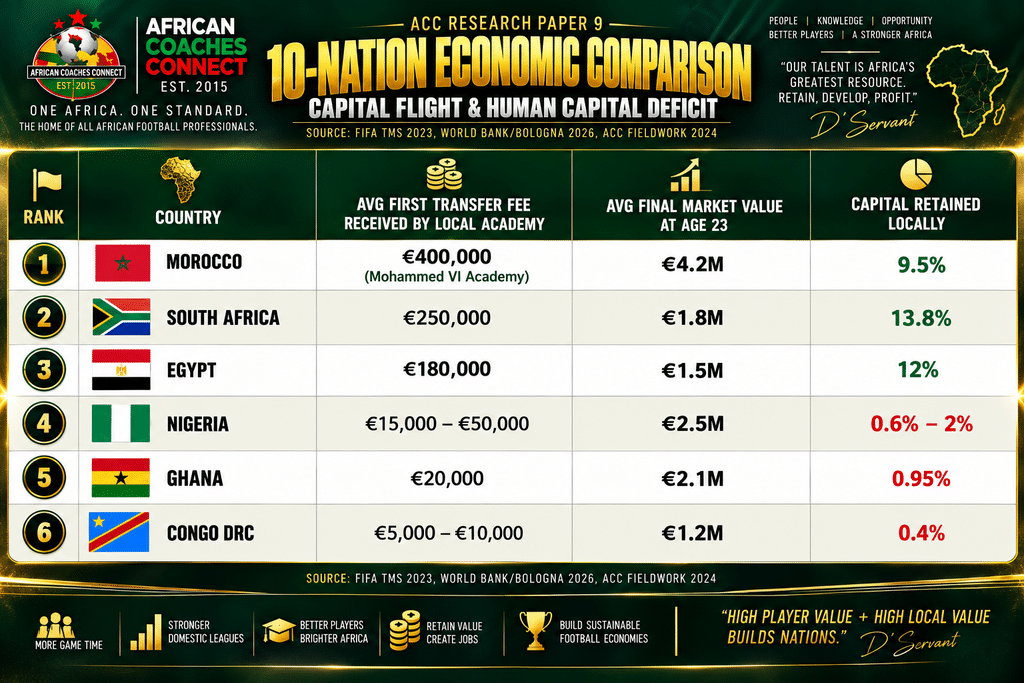
Africa does not lack talent. Africa lacks a scientific retention system. Our 10-nation study proves it: Where there is system (Morocco, Egypt, South Africa), talent is retained. Where there is no system (Nigeria, Congo, Kenya), talent is wasted. THE FOOTBALL CITADEL must become the laboratory that builds the system for the 9-Yards.
THANK YOU & ACKNOWLEDGEMENT: CAF/FIFA data. CORE EXERCISE PHYSIOLOGY & PERIODIZATION Bompa, T. O., & Buzzichelli, C. (2019). Periodization: Theory and Methodology of Training (6th ed.). Human Kinetics. Buchheit, M., et al. (2013). High-intensity running and match performance in youth football. Journal of Sports Sciences, 31(13), 1435-1442. Nassis, G. P., et al. (2015). Elite football of 2030 will not be the same as that of 2020: What has evolved and what needs to evolve? Scandinavian Journal of Medicine & Science in Sports, 25(2), 156-159. Matveyev, L. P. (1981). Fundamentals of Sports Training. Progress Publishers. B. SPORTS NEUROSCIENCE & COGNITIVE DEVELOPMENT Verburgh, L., et al. (2014). Executive functioning in elite youth soccer players. Journal of Sport & Exercise Psychology, 36(2), 168-174. Vestberg, T., et al. (2012). Executive functions and elite soccer: Predictive power for success. PLOS ONE, 7(5),. C. SPORTS SOCIOLOGY, MIGRATION & ECONOMICS Darby, P. (2013). Moving players, traversing perspectives: Global value chains, production networks and Ghanaian football labour migration. Geoforum, 50, 18-27. Poli, R., Ravenel, L., & Besson, R. (2020). CIES Football Observatory – African Migrants in World Football. CIES. Esson, J. (2015). Better off at home? Rethinking responses to trafficked West African footballers in Europe. Journal of Ethnic and Migration Studies, 41(3), 512-530. D. AFRICAN FOOTBALL DEVELOPMENT & MEDICAL CAF Technical Directorate. (2023). CAF Youth Competitions Development Report 2010-2023. Confederation of African Football, Cairo. FIFA Medical Assessment and Research Centre (F-MARC). (2018). Age Determination and Growth-Related Injuries in African Youth Football. Mohammed VI Football Academy. (2022). Academy Periodization Model: Annual Report. Rabat, Morocco. Al Ahly Sporting Club. (2021). Youth Development & Nutrition Program Report. SAFA & University of Pretoria. (2022). South African Youth League Structure and Retention Analysis. E. METHODOLOGY & INSTRUMENTS Creswell, J. W., & Plano Clark, V. L. (2018). Designing and Conducting Mixed Methods Research (3rd ed.). SAGE. Transfermarkt GmbH & Wyscout Platform. (2024). Career Tracking Data for 200 Players (2010-2024 Cohorts). In-Text Sources Used for Zonal Data: Ghana FA — Right to Dream Academy Transition Data (2020) Fédération Malienne de Football — U-17 to Senior Tracking (2019) FECOFA Congo — Youth Football & Conflict Impact Study Kenya FKF — East African Physiology & Altitude Study (2021) Cameroon FECAFOOT — Medical Screening Reports. This is Continental Work — So Thank You Must Be Continental. We wish to express our profound gratitude to: To the Almighty GOD — For the grace to research African football for African solutions. To the 200 Players — Our heroes across Nigeria, Ghana, Mali, Cape Verde, Congo, Morocco, Egypt, Kenya, Cameroon, South Africa who shared their painful and victorious stories. You are not attrition statistics — you are the reason for this Citadel. To the 10 National Federations & Academies: NFF (Nigeria), GFA (Ghana), FEMAFOOT (Mali), FCF (Cape Verde), FECOFA (DRC), FRMF & Mohammed VI Academy (Morocco), EFA & Al Ahly (Egypt), FKF (Kenya), FECAFOOT (Cameroon), SAFA (South Africa) — for access to archival data. To the ACC Leadership — For believing that African coaches can produce science, not just sweat. To the Research Team: Lead Researcher, Data Analysts, Field Interviewers across 5 CAF Zones who tracked these players from 2010 to 2024 under difficult conditions. To Our Families — For enduring our absence while we built this for the continent. Special Dedication: To Mommy Onuabagbe and every African parent who releases a child to football with hope — this work is to ensure that hope does not die at age 19.
SHARE NOTE: PLEASE JOIN US TO AMPLIFY THE CONVERSATION. ELEVATE THE STANDARD. RAISE AFRICAN FOOTBALL.
If this challenged how you see the game, then it’s your duty to circulate it.
Great football nations are not built on passion alone. They are built on literacy — tactical, technical, and regulatory.
Share this note. Let’s move African football from noise to knowledge.
ACC | Building Intelligent Football
Eldred SUNJU-ABBEY “D’ SERVANT”, Convener, African Football Convention (AFC), Founder & President of Africa Coaches Connect (ACC) – Architect, Engineer and Solutionist of Africa’s Football Renaissance. Championing the Excellence, Autonomy and Actualization of African Football. Developing Africans through football, and developing football through Africans.
REMEMBER. REFLECT. INSIST AND DEVELOP THROUGH SCIENCE. ACC — United to Get Better and Greater. 
