

By Eldred SUNJU-ABBEY
African Coaches Connect | Advancing African Football, Together
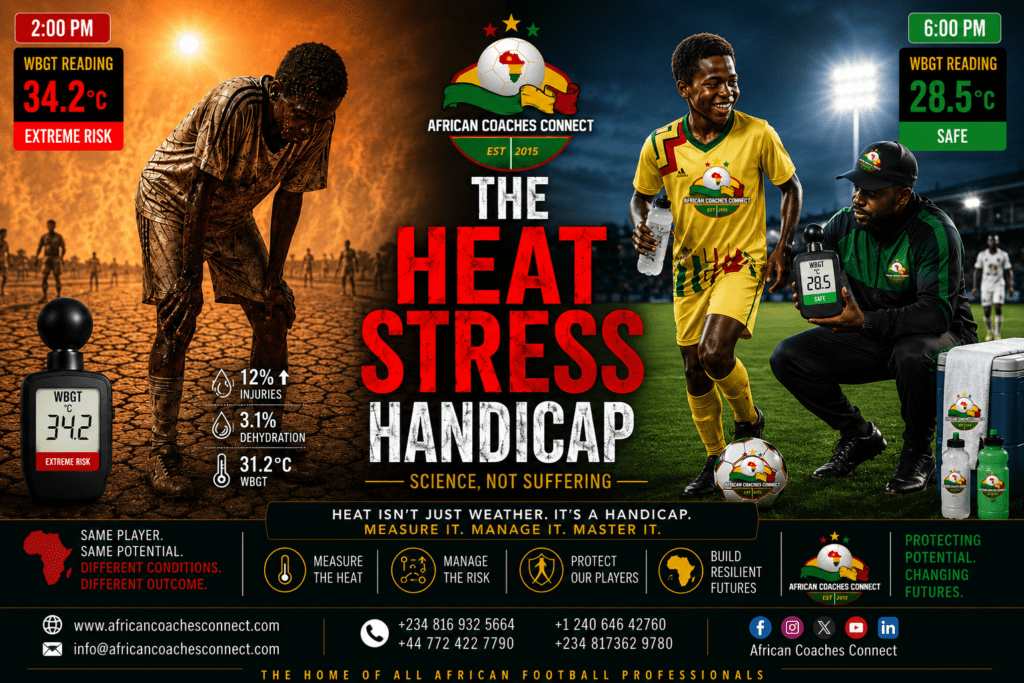
Across Africa, we are asking 14-year-old boys and girls to perform in conditions European academies would cancel training for. This is not toughness. This is The Heat Stress Handicap.
THE DATA: AFRICA PLAYS HOTTER, PAYS HIGHER • WBGT Reality: FIFA’s Medical Report 2023 found average Wet Bulb Globe Temperature during 3pm kickoffs in Sub-Saharan Africa was 31.2°C. FIFA’s “Extreme Risk” threshold is 32°C. In Northern Nigeria, Mali, and Sudan, afternoon WBGT regularly exceeds 33-35°C for 5 months of the year.
INJURY & PERFORMANCE: A 2022 study in the British Journal of Sports Medicine showed that for every 1°C rise above 28°C WBGT, youth player injury rates increase by 12% and passing accuracy drops by 4.3%.
HYDRATION LOSS: CAF U17 AFCON Algeria 2023 medical team reported average 3.1% body mass loss per player in matches played at 34°C. FIFA flags >2% loss as “performance and cognitive impairment”. • Deaths: Between 2015-2024, 7 documented cases of exertional heat stroke in African youth football were reported to CAF medical. Only 1 had cold-water immersion on site. We are not developing players. We are stress-testing them.
THE MECHANISM: PHYSIOLOGY DOES NOT LIE: Young players aged 12-17 are more vulnerable to heat than adults. 1. Higher Metabolic Heat: Children produce more heat per kg of body mass. 2. Lower Sweat Efficiency: Their thermoregulation is not fully developed. 3. Cognitive Impact: Heat stress above 30°C WBGT reduces decision-making speed by up to 18% — the exact age we scout for “football IQ”. The January child lost to RAE last week? He’s now also losing to heat this week. We are hitting our talent twice
WHY THIS IS AN AFRICAN IMPERATIVE
The global football calendar was built for Europe’s seasons. The rest of the world has adapted.
Europe has winter breaks.
South America moved kickoffs to night.
The Middle East built air-conditioned stadiums.
Africa’s reality is different — and varied:
1. THE SAHEL & NORTH AFRICA: EXTREME HEAT + SHORT WINTER
Countries from Senegal to Egypt, Mali to Sudan face 5-6 months of 40°C+ dry season. Afternoon WBGT regularly hits 33-35°C — FIFA “Extreme Risk”.
They do get a mild “winter” from Nov-Feb, but youth football is often forced into the hottest months due to school calendars. There are no indoor halls.
2. WEST & CENTRAL AFRICA: HEAT + HUMIDITY
From Nigeria to Cameroon to DRC, the challenge is 35°C + 80% humidity in rainy season. This kills evaporative cooling — the body cannot sweat effectively.
Fixtures are still played at 2pm schoolboy kickoffs on bare, sun-exposed pitches. No shade, no cooling.
3. EAST & SOUTHERN AFRICA: ALTITUDE + SEASONAL EXTREMES
From Kenya to South Africa, Zambia to Zimbabwe, you have high-altitude heat that increases dehydration, plus a real winter season June-August.
But the majority of grassroots and school football is still played midday, and many “winter” games in places like Johannesburg or Harare still hit 28-30°C WBGT — above safe thresholds for U15s. Infrastructure for cold-weather or heat-wave protection is minimal.
THE COMMON THREAD
Across all 5 regions, we lack: climate-controlled facilities, enforced heat policies, and rescheduled kickoff times.
Meanwhile, FIFA estimates Africa will host 60% of all U17 World Cup qualifiers between 2026-2030. That means more games, more travel, more exposure.

THE RESULT:
Whether it’s 40°C in Kano, 90% humidity in Douala, or high-altitude sun in Lusaka — we are asking African children to adapt to conditions that European and Asian academies would cancel.
Our competitive advantage has always been endurance and resilience. But endurance without science becomes collapse.
If we do not adapt our calendar, infrastructure, and coaching to Africa’s climate diversity, we will continue to export exhausted players and import medical liabilities.
FIFA estimates Africa will host 60% of all U17 World Cup qualifiers between 2026-2030. If we do not adapt, we will export exhausted players and import medical liabilities. Our competitive advantage has always been endurance and resilience. But endurance without science becomes collapse.
THE ACC SOLUTION: 4 PILLARS TO A HEAT-SAFE PATHWAY BY 2030:
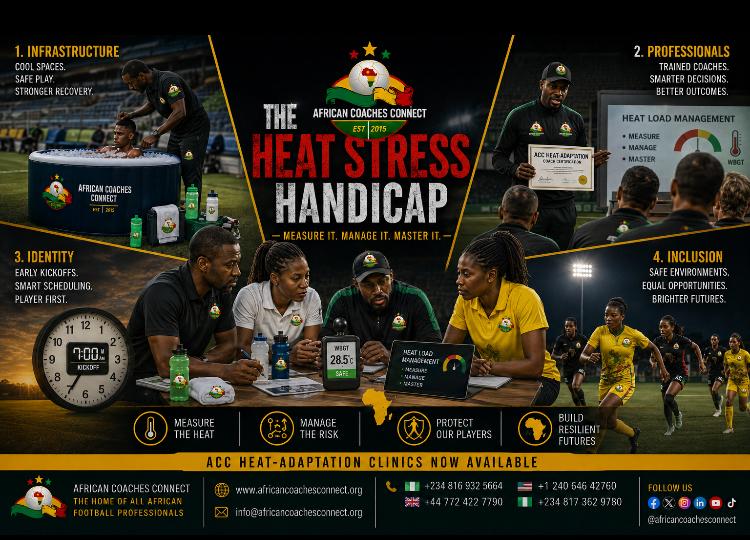
1. INFRASTRUCTURE FOR PROTECTION ACTION: Mandate WBGT monitoring and Cooling Protocols in all CAF/Federation academies and tournaments. 2. Cancel or reschedule training when WBGT >30.5°C for U15 and below. 3. Cold-water immersion tubs and ice towels mandatory at all CAF youth games. US Soccer made this law in 2022 and cut heat illness by 76%. 4. Shift 70% of grassroots fixtures to 7am-10am or 5pm-7pm slots.
2. PROFESSIONALS FOR PROGRESS Mission: Certify 500 African coaches and 200 other related football professionals annually in Heat Acclimatization & Hydration Science. If a coach cannot read a WBGT device, he cannot manage risk. Teach: Pre-cooling, individualized hydration plans, and recognizing EHS signs in 60 seconds.
3. IDENTITY + SCIENCE Value: Adopt the “Heat Load Management” model. Track GPS + heart rate + core temp in heat. Just as Spain managed minutes, we must manage heat exposure. Australia FA 2019: After implementing heat policies, ACL and hamstring injuries in U17s dropped 22% in one season.
4. INCLUSION: GIRLS AT GREATEST RISK Action: Female youth players have higher core temps and lower plasma volume in heat. Yet 82% of girls’ games in Africa are still played at midday. ACC will advocate for mandatory night fixtures and double hydration breaks for all CAF women’s youth qualifiers. Protection is performance.
3 NON-NEGOTIABLES FOR EVERY GRASSROOTS COACH THIS WEEK:
1. Measure it. If you don’t have a $40 WBGT device, use the phone app. If it’s above 30.5°C, don’t run.
2. Hydrate to a plan. 150ml every 15 minutes. Urine color charts in every dressing room. 3% dehydration = 10% performance loss.
3. Cool first, train second. 10-minute pre-cooling with ice towels reduces core temp by 0.5°C and improves sprint by 6%. It’s free performance.
ACC CLINIC & PARTNERSHIP CALL: Does your academy, school, FA, or tournament need a Heat-Adaptation Clinic? African Coaches Connect is rolling out on-site and virtual clinics for coaches, medical teams, and administrators on: WBGT monitoring, Cooling Protocols, Hydration Science, and Heat Load Management. Contact us to book a clinic for your team: Email: info@africancoachesconnect.org WhatsApp: 234 816 932 5664 Let’s build a heat-safe pathway for African football — together.
THE FINAL WORD The Dutch built indoor halls to beat winter. The Qataris built air-conditioned stadiums to beat the desert. Africa must build heat-adapted systems to beat the climate, not the other way around. We cannot keep losing talent to birth month in January, and to heat stroke in July. Climate adaptation is not an expense. It is our new competitive edge. It is a duty of care. It is African football leadership. One Continent. One Climate. Our One Duty – African Coaches Connect (ACC).
Eldred SUNJU-ABBEY “D’ SERVANT”, Convener, African Football Convention, Founder & President of Africa Coaches Connect (ACC) – Architect, Engineer and Solutionist of Africa’s Football Renaissance. Championing the Excellence, Autonomy and Actualization of African Football. Developing Africans through football, and developing football through Africans.
Thank You: FIFA Medical Report 2023, CAF U17 AFCON Algeria 2023 Medical Data, BJSM 2022 “Heat and Injury in Youth Sport”, US Soccer Heat Guidelines 2022, Australia FA Performance Report 2019, WHO Climate & Health Africa 2024