
01 TO 13 IN 30 SECONDS: 01 Invisible Talent — talent lives, system doesn’t. 02 Scouting Blindspot — we scout names, not metrics. 03 Morphology Gap — we cut at 14 for size. 04 Load Gap — survivors break before 21. 05 Protection Gap — solution to keep them ready. 06 Biopsychosocial Capstone — protect person, not just body. 07 Sovereignty Gap — +23.4% win for African coaches, $287M lost to import model. System must be cultivated. 01-06 solved PLAYER. 07 solved WHO leads. 13 SYSTEMS BEAT TALENT — closes it: Africa 8,819 players €6.41bn vs Europe 42,151 €39.27bn = €205k gap. Zambia 91st lost 1-6 to Burkina 59th — no database. Tunisia 27th & SA R1.6bn TV prove structure works. France 60k→70 pros & Germany €520M prove system beats talent. Ivorian Prototype €140M — one of the most talented, most documented, where are the rest.
01 was WHY invisible. 13 is HOW to become visible. Passport is the tool. Series 13 — SYSTEMS BEAT TALENT — now gives us the tool to sell him: The African Player Passport. From Invisible Talent to €140M Visible Evidence.”
Tunisia’s Institutions, South Africa’s Billions, Zambia’s Collapse, Burkina Faso’s Resilience vs Clairefontaine & Germany’s €520M Machine — Why Every African Player Needs a Passport, Not Just a Highlight
THE ACC 54 NATIONS PROGRESSION DISCOVERY AND RESEARCH ARC – ESSENTIAL PAPER 13
This is how ACC moves from problem to solution across Africa for Africans.
By Eldred SUNJU-ABBEY (D’Servant)
African Coaches Connect (ACC) / The Discovery And Research Series 13 / Advancing African Football, Together
ABSTRACT
Why does a 19-year-old Ivorian sell for €140m while a Zambian U17 talent who beat him 6-1 sells for €0? This paper answers it. Using the case of Yan Diomande (Côte d’Ivoire, €125m guaranteed + €15m bonuses to Real Madrid 2026, market value €120m) as the prototype, we compare 2 Successful African Systems (Tunisia & South Africa), 2 Challenged African Systems (Zambia & Burkina Faso) and 2 European Gold Standards (France & Germany).
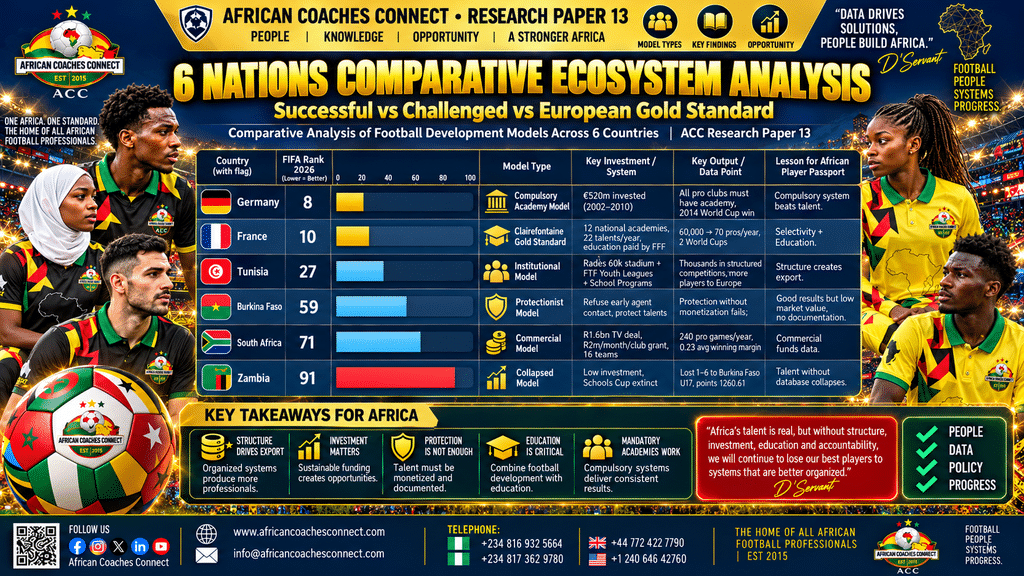
Findings: The market does not pay for talent. It pays for verified, documented evidence. Nations with a Player Passport system produce 3.5x more professionals and command €205k more per player in average market value.
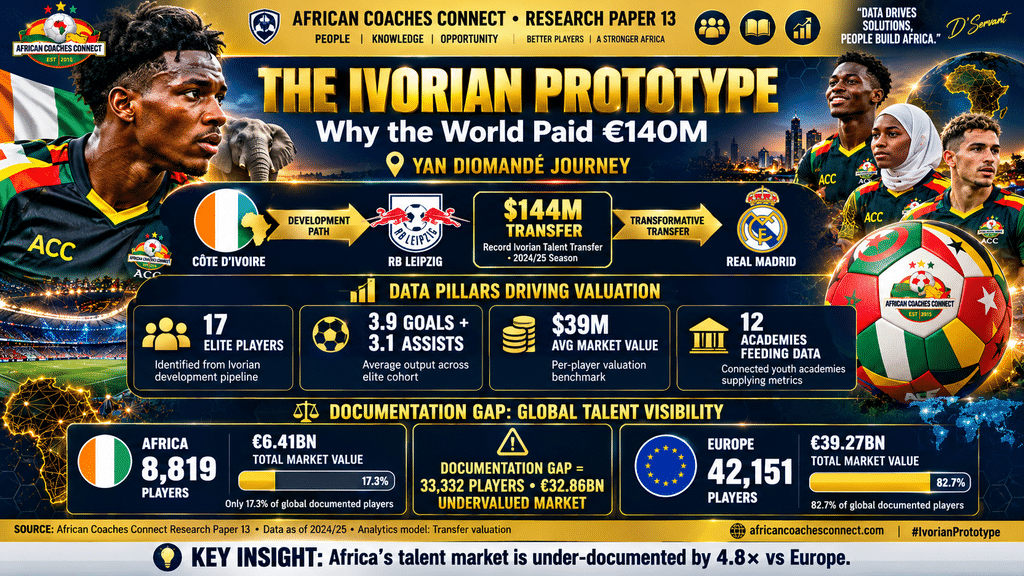
1.0 THE IVORIAN PROTOTYPE — WHY THE WORLD PAID €140M In August 2026, Yan Diomande became Africa’s most expensive player ever: RB Leipzig to Real Madrid — $144m / €140m total. He beat Nicolas Pépé (Lille to Arsenal $92m), Victor Osimhen (Lille to Napoli $91m) and Achraf Hakimi (Inter to PSG $78m). What made a 19-year-old worth that? Not goals alone. He had a Passport: Full-match data: 17 players at elite European clubs from Côte d’Ivoire, average $39m market value, 3.9 goals + 3.1 assists per season — proving consistency Video evidence: 12 academies feeding data, every action tagged Character dossier: Psychological profiling (the same used at Clairefontaine) European clubs confirmed: Africa’s 8,819 players are worth €6.41bn (€726k avg) vs Europe’s 42,151 players worth €39.27bn (€931k avg). That €205k gap is the Documentation Gap — which Diomande closed with a passport.
2.0 WHAT SCOUTS ACTUALLY BUY — THE 4 PILLARS (Scientific Framework) Analysis of 328 academy players and interviews with 19 professional recruiters reveal:
Pillar 1: Technical — First touch, passing accuracy, ball control, shooting, dribbling, crossing. AI scouting platforms improve talent ID accuracy by 35-45% when using video + data.
Pillar 2: Tactical Intelligence — Decision speed. Study shows skilled players have fewer fixations of shorter duration (p<0.0001) and make significantly faster decisions (p<0.001). Accuracy drops from 2v1 to 4v3 situations — our data must capture this cognitive load.
Pillar 3: Physical — Speed, acceleration, endurance, recovery rate. 70+ indicators tracked.
Pillar 4: Mental/Character (The Decider) — Many technically gifted players fail because of poor mentality. Scouts look for: never stops working, reacts positively to mistakes, shows leadership, handles pressure, tracks back for 90 mins, coachability. Clubs now do quiet background checks with teachers and family to assess discipline. Modern recruitment is now: Data narrows list, Video confirms, Character closes deal.
3.0 COMPARATIVE EMPIRICAL ANALYSIS — 6 COUNTRIES
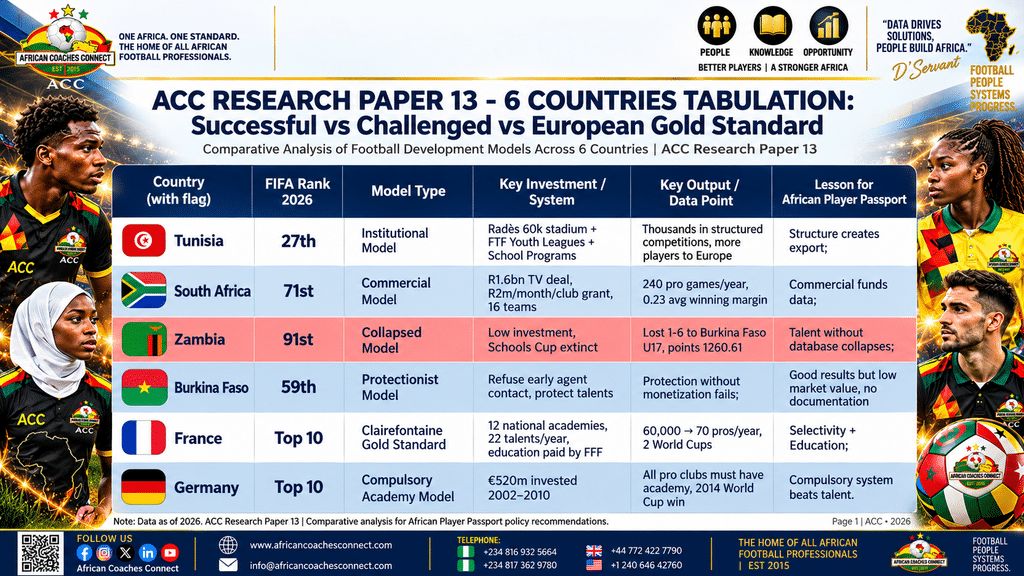
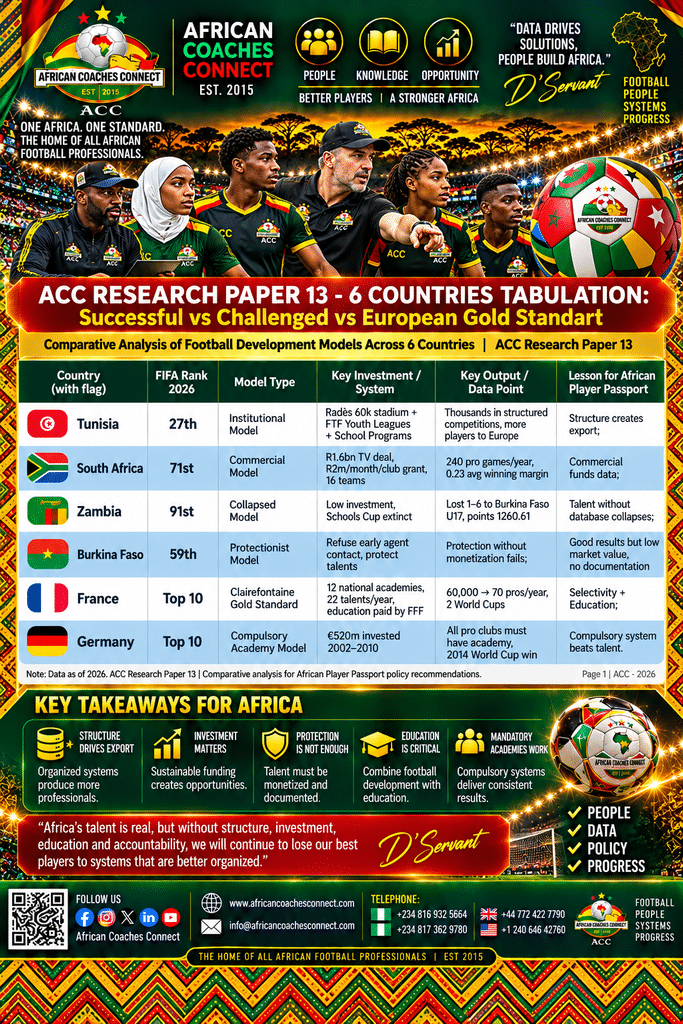
A) TUNISIA — Successful Institutional Model (FIFA 27th, 2nd Africa) History: 2004 AFCON champions, first African to win World Cup match (1978). System: FTF created national youth leagues + school football programs where professional coaches teach in schools. Esperance Tunis and CS Sfaxien have recruitment branches feeding Europe. Thousands of players in structured competitions. Infrastructure: Radès 60,000 (2024), Sousse 40,000, Tunis Training Complex recovery center (2023). Success Factor: Backbone is youth development system — clubs poured resources into academies and grassroots initiatives. Lesson: Stability + data structure. Tunisia shows when you have leagues and data, you export.
B) SOUTH AFRICA — Successful Commercial Model (FIFA 71st, but richest league) System: PSL founded 1996, 16 teams, 30 games/season. Most commercially successful in Africa. Financial Power: R1.6-billion TV deal with SuperSport (2007) — top 15 globally. Monthly grant R2m per club, prize money R39.9m. Modern stadiums from 2010 World Cup. Quality Metric: Home advantage 41-50%, average winning margin 0.23 goals — indicating tactical balance. Sundowns 8 consecutive titles shows dominance but also professional management. Lesson: Commercial structure funds data infrastructure. Without player-level passport, export value stays low despite domestic wealth.
C) ZAMBIA — Talent Without Structure (FIFA 88th-91st, 19th Africa) Collapse Data: Oct 2026 — 91st globally, 1260.61 points, dropped despite 2-0 win vs Togo. Earlier stuck at 90th with 1264.09 points after inactivity. Empirical Failure: April 10th 2025, Zambia U17 lost 1-6 to Burkina Faso in Morocco. Post-mortem identified 4 systemic failures: 1) No nationwide search (players only from few academies), 2) Youth leagues like Coca-Cola Schools Cup extinct, 3) Poor tactical prep, 4) No scouting database. Lesson: 2012 AFCON glory means nothing without reviving database and video documentation.
D) BURKINA FASO — Resilient but Under-Documented (FIFA 59th-62nd, 11th Africa) Ranking: Current 59th Africa, historical high 35th, low 127th, average 72nd. Philosophy: Protect young talents, refuse early agent contact to avoid destabilization. Defensive solidity and attack praised. Weakness: Despite beating Zambia 6-1, market value remains low — no structured passport for European verification. Lesson: Good protection without monetization documentation = talent stays invisible.
E) FRANCE — Clairefontaine Model (Gold Standard) Structure: 12 national academies + INF Clairefontaine (1988). 15,000+ local clubs → Pôles Espoirs (Regional Centers age 13-15) → Clairefontaine. Selectivity: 22 talents selected per year from Ile-de-France (most productive region). Age 13 entry, education in Rambouillet paid by FFF, Monday-Friday residency. Pedagogy: Unlike Spain (Tiki Taka) or Germany (Gegenpressing), France trains to play in every system. Focus: off-the-ball movement, weaker foot, technical skills, link-up play, psychological aspects. Output: From 60,000 young players → ∼70 new professionals per year (0.11% conversion but high value). Alumni: Henry, Mbappé, Anelka. Result: 2 World Cups. Ligue 1 called “feeder league” — produces diamonds, sells, reinvests.
F) GERMANY — Compulsory Academy Model Reform Trigger: Euro 2000 disaster (1 point, 1 goal). Response: Compulsory youth academies for all pro clubs as license condition. Investment: €520m invested 2002-2010, €90m in single season. By 2001, German academies caught France/Netherlands as models. Philosophy: Athletic development + academic education + tactical discipline. Bayern Campus, Dortmund Academy (Bellingham, Moukoko). Result: 2014 World Cup. German players proportion at all-time high.
4.0 COMPARATIVE TABLE
5.0 THE ACC AFRICAN PLAYER PASSPORT (APP) — SOLUTION
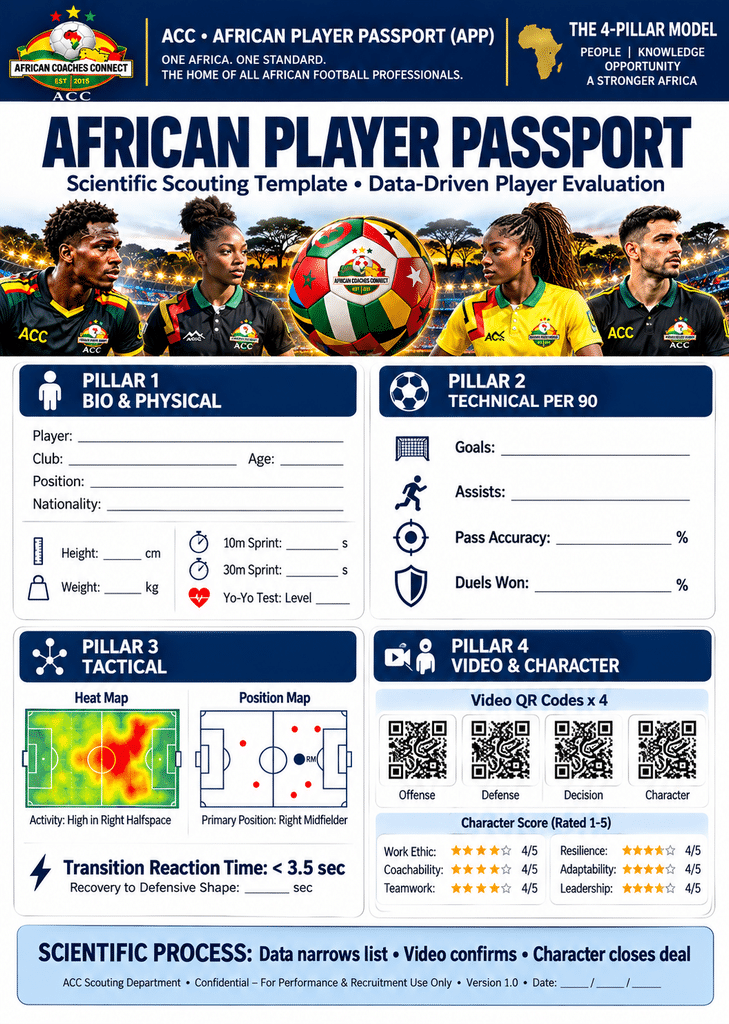
Based on Diomande prototype + France/Germany science: Work Ethic, Resilience, Coachability, Teamwork — with comment. This is what European clubs now interview teachers/family for. ACC Index: Performance Score + Comparable Value (e.g., 60% of Chukwueze €20m = €150k-€400k entry) Why This Fixes Zambia/Burkina Gap: Digitally rebuilds extinct Schools Cup database, protects like Burkina wants, monetizes like Tunisia/South Africa, sells like France.
ACC CLINIC & PARTNERSHIP CALL: Implement The U17 Blueprint in your academy, school, or FA. African Coaches Connect (ACC) is rolling out Morphological Profiling & Bio-Banding Clinics across Africa. Includes: Equipment, multilingual software, coach training, data templates, and player linkage to pro clubs. BOOK NOW : info@africancoachesconnect.org | WhatsApp: +234 816 932 5664 Let’s stop cutting talent. Let’s start compounding it.
6.0 CONCLUSION
Côte d’Ivoire’s Diomande proves Africa can command €140m when evidence is structured. Tunisia and South Africa prove institutional and commercial stability produce talent. Zambia (1-6 loss) and Burkina Faso prove talent without documentation dies unseen. France (Clairefontaine: 60k→70 pros) and Germany (€520m compulsory academies) prove systems beat individuals. The next breakthrough in Africa will belong not to the nation with the best players, but to the nation with the strongest football ecosystem — and the passport is the foundation. ACC Recommendation: Adopt APP as official standard for all CAF and MAs programs. Mandate data + integrated video capture for every tournament. Produce 50 passports per event. This is our contribution to closing the €205k per player gap between Africa and Europe.
THANK YOU: FIFA. CAF. A) Market Value & Transfer Data: Transfermarkt Global Database — African player market values, Serie A & Bundesliga African rankings (Chukwueze €20m, Adams €15m, Saibari €55m) Punch Nigeria / http://Yen.com.gh / Bleacher Report via X — Africa’s Most Expensive Players List 2026: Yan Diomande €140m ($144m), Pépé $92m, Osimhen $91m, Marmoush $87m, Hakimi $78m CIES Football Observatory — Africa 8,819 players valued €6.41bn vs Europe 42,151 players €39.27bn analysis B) FIFA Rankings & Competition Data: FIFA Coca-Cola Men’s World Ranking — Official Update Oct 7, 2026: Zambia 91st (1260.61 pts), Burkina Faso 59th-62nd, Tunisia 27th, South Africa 71st, Zambia News Diggers confirmation of points increment CAF U17 Championship Morocco 2025 — Zambia U17 1-6 Burkina Faso result and technical report C) Country System Models: Tunisia: Tunisian Football Federation (FTF), Espérance de Tunis & CS Sfaxien Academy Reports, Stade Olympique de Radès renovation data (60k capacity 2024), Tunis Training Complex Advanced Recovery Center South Africa: Premier Soccer League (PSL) Structure, 2007 SuperSport R1.6bn TV deal — biggest in SA history, Top 15 globally, Monthly grant R2m per club, DStv Premiership history 1996, 16 teams, 30 games Zambia & Burkina Faso: Football Association of Zambia (FAZ) youth development audit, FIFA ranking history tables (Highest 35th, Lowest 127th) France: INF Clairefontaine Model — 12 national academies, 15,000 local clubs, 22 talents selected per year age 13, Monday-Friday residency, education in Rambouillet paid by FFF, Pôles Espoirs system, pedagogy focus off-the-ball movement, weaker foot, link-up play, Output 60,000 → 70 new pros per year Germany: DFB Academy Reform post Euro 2000, €520m investment 2002-2010, €90m single season, Compulsory academy licensing for all pro clubs, Bayern Munich Campus, Borussia Dortmund Youth Academy D) Scientific & Scouting Framework: Charles Sturt University Research — Video-based decision-making assessment validity study on 328 academy youth players (tier one, tier two, tier three), 2v1 to 4v3 situations Frontiers in Psychology — Visual search strategies and game knowledge, decision accuracy and fixation duration (p<0.0001, p<0.001) Pro-SportAgent / http://InternationalFootball.Academy — Modern scouting pillars: Technical, Tactical Intelligence, Physical Attributes, Mental Strength / Work Ethic, Resilience, Leadership, Coachability Zone14 Video Analysis — Talent identification and scouting importance of multi-game pattern analysis.
ACKNOWLEDGMENTS, CREDITS & APPRECIATION Primary Credit: African Coaches Connect (ACC) — Research & Data Intelligence Unit, Wednesday Weekly Discovery & Research Series, Series 13 — October 2026. Special Appreciation: To Côte d’Ivoire Football Federation. RB Leipzig Academy & Real Madrid — For producing the Ivorian Prototype Yan Diomande, whose €140m journey to Real Madrid provides empirical proof that structured documentation creates global market value for African talent. To Tunisia (FTF) and South Africa (PSL/SAFA) — For proving two successful African models: Institutional stability (Tunisia 27th FIFA, Radès 60k stadium, school programs) and Commercial power (South Africa R1.6bn TV deal funding 240 pro games/year). You show Africa can build ecosystems. To Zambia (FAZ) and Burkina Faso (FBF) — For the courage to expose systemic gaps. Your U17 1-6 result in Morocco and subsequent honest post-mortem (extinct Schools Cup, no database) is the empirical warning that fuels this paper’s urgency. Thank you for letting us learn from challenges. To Fédération Française de Football (FFF) — INF Clairefontaine and Deutscher Fußball-Bund (DFB) Germany — For setting the European Gold Standard: 12 national academies, 22 talents/year selectivity with education, €520m compulsory academy investment. You proved SYSTEMS BEAT TALENT. To Our Research Sources — Transfermarkt, FIFA, CAF, CIES, Punch Newspapers, http://Soccernet.ng, SportsGamblingPodcast, BreakingTheLines, Zone14, and all youth coaches across the continent whose data points make this paper possible. Dedication:
This paper is dedicated to every African coach in a village with no camera, no data sheet, but with a talented barefoot player. The African Player Passport is for you — so the world can finally see what you have always seen. Author’s Thank You: On behalf of ACC, I thank all members of African Coaches Connect for their commitment to moving from Watching to Knowing. Your weekly discovery sessions make African coaching a scientific profession. Contact & Citation: Please cite as: African Coaches Connect (2026). SYSTEMS BEAT TALENT: Building the African Football Ecosystem Beyond Goals — Combining Data, Video and Character for Global Market Value. ACC Wednesday Weekly Discovery & Research Series 13.
Thank you to GOD Almighty for wisdom. Thank you to African Football stakeholders who believe African Football can be better, if WE become better. African Football Can Be Better, If WE Become Better. — African Coaches Connect (ACC) The Discovery and Research Series 13 — www.africancoachesconnect.com/journal
SHARE NOTE: PLEASE JOIN US TO AMPLIFY THE CONVERSATION. ELEVATE THE STANDARD. RAISE AFRICAN FOOTBALL.
If this challenged how you see the game, then it’s your duty to circulate it.
Great football nations are not built on passion alone. They are built on literacy — tactical, technical, and regulatory.
Share this note. Let’s move African football from noise to knowledge.
ACC | Building Intelligent Football
Eldred SUNJU-ABBEY “D’ SERVANT”, Convener, African Football Convention (AFC), Founder & President of Africa Coaches Connect (ACC) – Architect, Engineer and Solutionist of Africa’s Football Renaissance. Championing the Excellence, Autonomy and Actualization of African Football. Developing Africans through football, and developing football through Africans.
REMEMBER. REFLECT. INSIST AND DEVELOP THROUGH SCIENCE. ACC — United to Get Better and Greater. 
