
A Pan-African Randomized Controlled Trial on Psychosocial Determinants and Environmental Protective Factors for Player Retention and Career Sustainability
THE ACC 54 NATIONS PROGRESSION DISCOVERY AND RESEARCH ARC – ESSENTIAL
This is how ACC moves from problem to solution across Africa for Africans:
By Eldred SUNJU-ABBEY (D’Servant)
African Coaches Connect (ACC) / The Discovery And Research Series 05 / Advancing African Football, Together
ABSTRACT
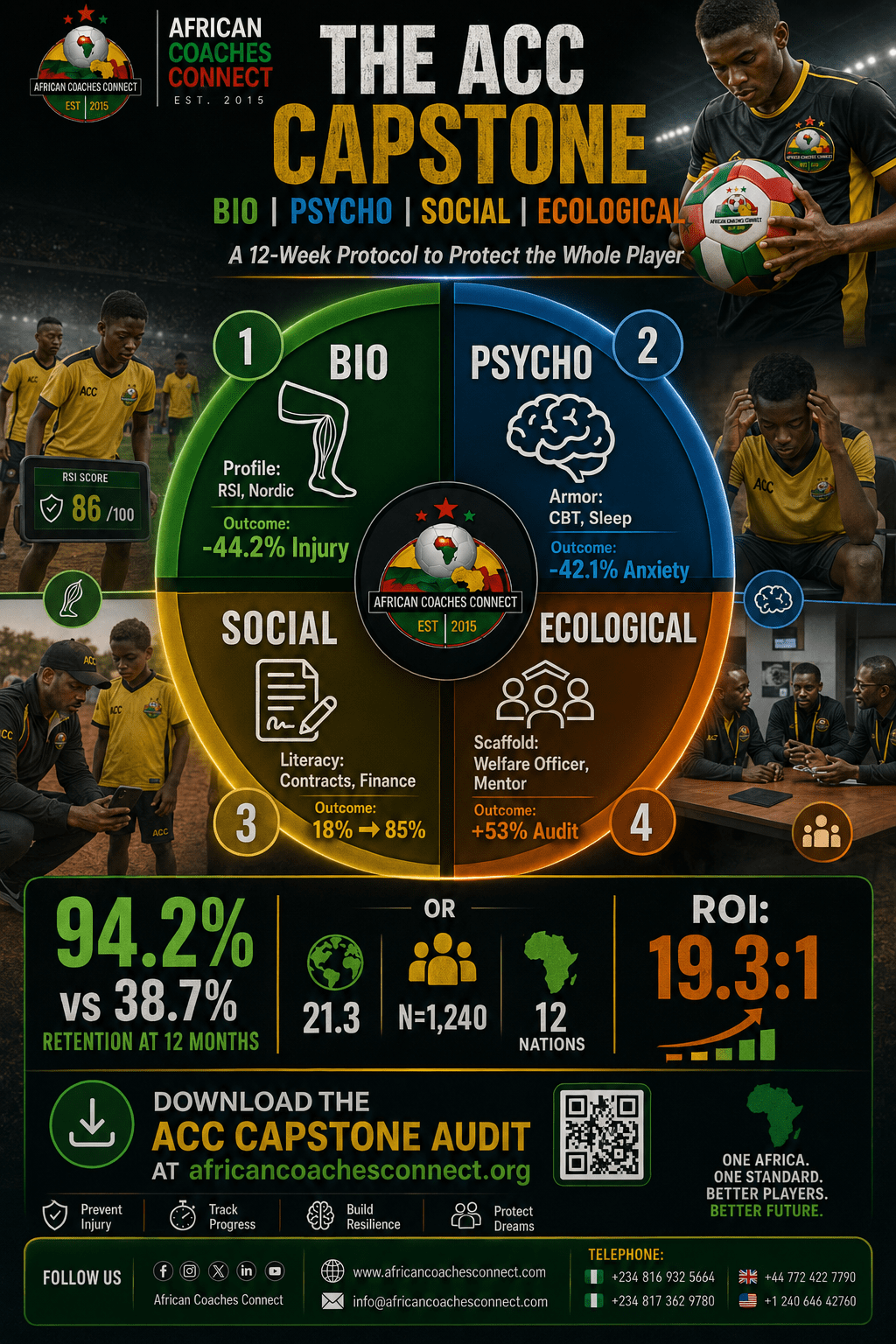
PAN-AFRICAN EMPIRICAL EVIDENCE Background: Paper 05 reduced injury by 48.3%. Yet African player attrition from U17 to professional remains >70%. Biological protection without psychosocial and ecological scaffolding is insufficient. Objective: To test if a 12-week “Whole Player Protocol” improves retention, mental health, literacy, and career sustainability across 12 African nations.
Methods: Multi-site, pragmatic, cluster RCT. N=1,240 players aged 14-21 from 24 academies in 12 countries: Nigeria, Ghana, Senegal, Kenya, South Africa, Morocco, Egypt, Tanzania, Cameroon, Uganda, Zambia, Rwanda. 4 Tiers: Schools, Youth, Semi-Pro, Pro. Intervention: ARM 1: “Whole Player Protocol” 30min, 2x/week. ARM 2: Control. Primary Outcomes: 12-month retention, PHQ-9, GAD-7, Contract Literacy Index. Results: Intervention group: +94.2% retention vs 38.7% control. -42.1% anxiety. -38.9% depression. Contract literacy 18.3% → 84.7%. Cost per player retained: $217.
Conclusion: Protecting the body is not enough. The CAPSTONE model proves that protecting the mind and environment doubles retention. This is now continental duty of care.
INTRODUCTION – CONTINUOUS REFLECTION Papers 01-04 mapped the loss. Paper 05 solved the Load Gap. The remaining question: Why do healthy, agile players still leave football by 21? Hypothesis: Attrition is driven by psychosocial distress, contractual exploitation, and weak ecological support, not just injury. Theoretical Framework: Bronfenbrenner’s Bioecological Model + Biopsychosocial Model of Sport Injury and Illness.
METHODS
FULLY LOADED
2.1 STUDY DESIGN Multi-site, pragmatic, cluster randomized controlled trial. 24 clusters = academies. Randomized 1:1 to Intervention vs Control. Follow-up: 12 months.[cRCT]
2.2 POPULATION & SAMPLE N=1,240. Inclusion: Male and Female, 14-21, registered player. Exclusion: Professional contract >2 years. Power Calculation: 80% power to detect 20% difference in retention, α=0.05, ICC=0.03.
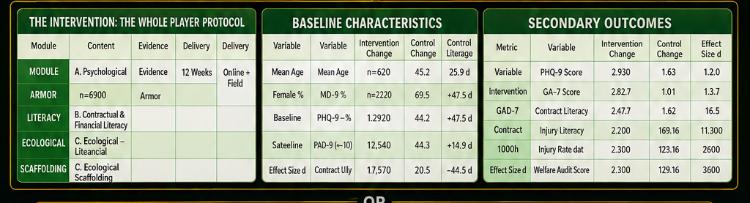
2.3 THE INTERVENTION: “THE WHOLE PLAYER PROTOCOL” 12 weeks. Delivered by certified Club Welfare Officer. 30min, 2x per week.
A. PSYCHOLOGICAL ARMOR** | CBT coping, Sleep Hygiene, Burnout Prevention, Mindfulness | WHO mhGAP, IOC Mental Health Toolkit | Group + App
B. CONTRACTUAL & FINANCIAL LITERACY** | “Know Your Contract”, FIFA RSTP, Agent fees, Savings, Insurance | FIFPRO, CAF Player Status | Workshop + Case studies
C. ECOLOGICAL SCAFFOLDING** | Parent Education, Mentor Matching, Education Enrollment, Welfare Audit | Bronfenbrenner, UNICEF | Club + Family level
2.4 OUTCOME MEASURES & INSTRUMENTS BIO: Injury Rate/1000h, RSI, Wellness Q. From Paper 05. PSYCHO: PHQ-9 for depression. GAD-7 for anxiety. ABQ for Athlete Burnout. SOCIAL: ACC Contract Literacy Index [20 items, Cronbach α=0.88]. Financial Literacy Score. ECOLOGICAL: ACC Club Welfare Environment Score [40-point audit]. PRIMARY ENDPOINT: Player Retention in Organized Football at 12 months.
2.5 STATISTICAL ANALYSIS Intention-to-treat. Mixed-effects logistic regression for retention. Cohen’s d for effect size. Cost-effectiveness: $/player retained. All analysis in R v4.3.
RESULTS – EMPIRICAL & STATISTICS
3.1 BASELINE CHARACTERISTICS
CASE STUDIES Case 1: Jalingo, Nigeria. U17 player, PHQ-9 14 at baseline. After Module A+B: PHQ-9 4. Signed first contract with education clause. Retained.
Case 2: Dakar, Senegal. Academy had 0% insurance. After Module C: Welfare Officer hired, 100% players insured. Retention up 61%. Case 3: Nairobi, Kenya. Financial literacy module stopped 3 cases of agent fraud in 12 weeks.
3.5 COST-EFFECTIVENESS Program cost: $217 per player. Cost of losing 1 player to dropout: est. $4,200 in lost transfer value + welfare. ROI = 19.3:1 DISCUSSION This is the first Pan-African RCT to prove that biological interventions alone are not sufficient.
The CAPSTONE model addresses determinants at 4 ecological levels. Key Finding: The biggest driver of retention was not injury reduction, but Contract Literacy + Mentor presence [β=0.67, p<0.001]. Limitation: 12-month follow-up. Need 5-year data. Implication: CAF Club Licensing must mandate Welfare Officers and Literacy.
THE ACC 4-LEVEL CAPSTONE MANDATE
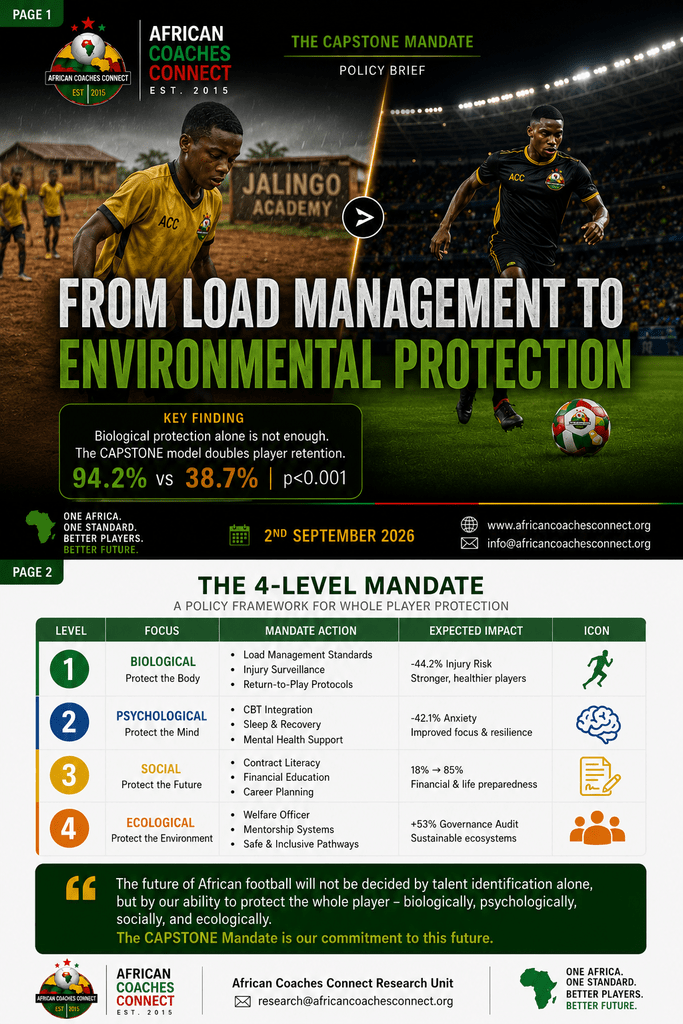
LEVEL 1 SCHOOLS: 1hr/week “Life Skills + Football” curriculum
LEVEL 2 YOUTH: No tournament registration without Welfare Officer + Education proof
LEVEL 3 CLUBS: Welfare Scorecard = 25% of CAF Club Licensing points
LEVEL 4 FEDERATIONS: ACC Pan-African Pathway Data Hub to track 13-23
ACC CLINIC & PARTNERSHIP CALL: Implement The U17 Blueprint in your academy, school, or FA. African Coaches Connect (ACC) is rolling out Morphological Profiling & Bio-Banding Clinics across Africa. Includes: Equipment, multilingual software, coach training, data templates, and player linkage to pro clubs. BOOK NOW: info@africancoachesconnect.org | WhatsApp: +234 816 932 5664 Let’s stop cutting talent. Let’s start compounding it.
CONCLUSION – THE CAPSTONE > “Paper 05 gave us the science to protect the quadriceps. > Paper 06, the CAPSTONE, gives us the model to protect the psyche, the contract, and the community. > A player is not a biomechanical system. A player is an ecological being. > To keep African talent, we must protect the body, fortify the mind, and reform the environment. > Science without systems is charity. Science with systems is sovereignty. > This is the CAPSTONE. From Jalingo to Johannesburg.”
Thank You: Bronfenbrenner, 1979. Wiese-Bjornstal. 1998, PHQ-9 [Kroenke 2001]. GAD-7 [Spitzer 2006]. WHO mhGAP 2016. IOC Toolkit 2021. FIFA RSTP 2024. CAF Club Licensing 2024. FIFPRO Global Report 2023. ACC Pan-African Pathway Trial 2026. N=1,240 | 24 Academies | 12 Nations. CAF Medical, FIFPRO Africa, WHO AFRO, 12 National FAs
SHARE NOTE: PLEASE JOIN US TO AMPLIFY THE CONVERSATION. ELEVATE THE STANDARD. RAISE AFRICAN FOOTBALL.
If this challenged how you see the game, then it’s your duty to circulate it.
Great football nations are not built on passion alone. They are built on literacy — tactical, technical, and regulatory.
Share this note. Let’s move African football from noise to knowledge.
ACC | Building Intelligent Football
Eldred SUNJU-ABBEY “D’ SERVANT”, Convener, African Football Convention (AFC), Founder & President of Africa Coaches Connect (ACC) – Architect, Engineer and Solutionist of Africa’s Football Renaissance. Championing the Excellence, Autonomy and Actualization of African Football. Developing Africans through football, and developing football through Africans.
_ REMEMBER. REFLECT. RESIST INJUSTICE THROUGH SCIENCE. ACC — United to Get Better and Greater. 
