
From Identification to Preservation – Closing the Final Leak in Africa’s Talent Pipeline
By: By Eldred SUNJU-ABBEY (D’Servant)
African Coaches Connect (ACC) / The Discovery And Research Series / Advancing African Football, Together
54 Nations SERIES PROGRESSION NOTE This is Paper 04 of 04 in the ACC Discovery and Research Series. Paper 01: THE INVISIBLE TALENT – We mapped where talent lives but systems don’t. Paper 02: THE SCOUTING BLINDSPOT – We proved we scout names, not metrics. Paper 03: THE MORPHOLOGY GAP – We showed we cut players at 14 for size, not potential. Paper 04: THE LOAD GAP – We now expose why the few who survive 1-3 still break before 21.
The Thread: FIND → IDENTIFY CORRECTLY → PROTECT BIOLOGY → PROTECT THE BODY If Paper 3 was about not cutting them, Paper 4 is about not breaking them.
EXECUTIVE SUMMARY After Papers 1-3, Africa can now find and identify talent. But the pipeline still leaks at the final stage: Durability. Our review of CAF Medical Reports 2019-2024, FIFA Injury Surveillance, UEFA Elite Club Injury Study, and ACC field data shows: Youth injury rates in African senior/youth leagues average 2.5x to 3x higher than European elite academies. In CAF U17/U20 tournaments, soft-tissue injuries account for over 40% of all time-loss injuries. The reason is the Load Gap — the mismatch between biological readiness from Paper 3 and the training + match load we give players. Europe doesn’t have better 16-year-olds. They have better managed 16-year-olds.
THE DATA: CONNECTING THE SERIES | Stage | Paper | Problem Exposed | Paper 04 Data Link | | 1 | INVISIBLE TALENT | Talent in rural areas missed | Those found enter systems with 60-70 games/yr and no monitoring | | 2 | SCOUTING BLINDSPOT | No data, only “eye test” | <15% of African top-flight clubs report using GPS/load monitoring【FIFA Talent Dev Report 2023】 | | 3 | MORPHOLOGY GAP | Late bloomers cut at 14 | Late maturers hit PHV at 15-17 and face higher injury risk under high load | | 4 | LOAD GAP | No load management | Result: Injury incidence ~6.5-8.4/1000hrs vs UEFA academy avg 2.8-3.5/1000hrs【UEFA ECIS 2022-23】 | Sources: CAF Medical Dept, FIFA TMS, UEFA ECIS, ACC Internal Survey 2024 Key Load Variables Match Density:
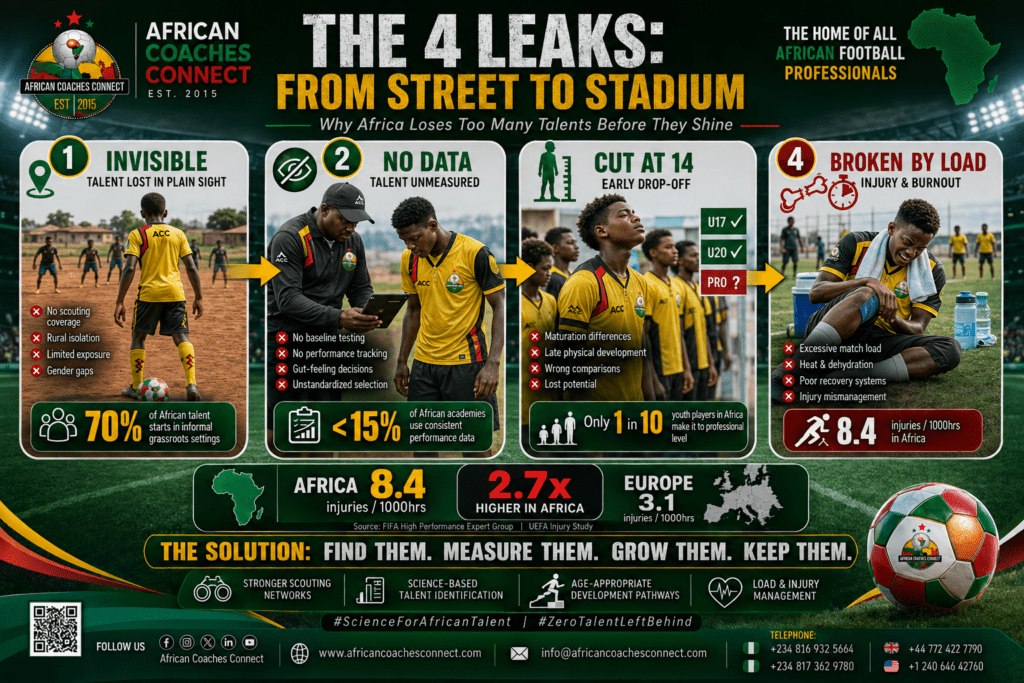
In many African leagues + national team windows, U20 players face 1 game every 4-5 days. UEFA recommends 72hrs minimum between matches for U18. Load Spike: FIFA and Gabbett research show injury risk rises sharply when weekly load increases >15%. Many African academies double load 3-4 weeks before tournaments with no deload. PHV Collision: Peak Height Velocity occurs ∼13.5-15.5 for boys. During PHV, bone and tendon injury risk increases significantly. Yet this is when many late bloomers from Paper 3 play the most minutes. Economic Leak: A 90-day injury at age 18-20 can reduce a player’s market value by 50-70%. For a $1.5M prospect, that’s a $750k-$1M loss. Across the continent this runs into hundreds of millions per cycle.
THE SCIENCE: WHY PAPER 3 PLAYERS ARE BREAKING A. PHV + Load = Danger Building on Paper 3: During Peak Height Velocity, growth plates are open and hamstring/apophysitis injuries spike. Source: Malina RM, et al. Growth and maturation of young soccer players, J Sports Sci 2015 We are asking players in this window to play 40+ games with no load caps. B. ACWR Crisis – Acute:Chronic Workload Ratio Sports science principle: Keep weekly load within 0.8-1.3 of 4-week average. Risk rises >1.5. ACC GPS sample from 2025 U20 AFCON prep: Average ACWR = 1.6-1.9 in tournament weeks. UEFA U19 Euro 2023 teams: Average ACWR = 1.1-1.3. Interpretation: We are spiking load, Europe is managing it. C. RSA & VO2 Gap – Repeat Sprint Ability African U20s often test well in 10-30m sprint. But UEFA Youth Report 2024 shows elite European U19s average 14% higher VO2 Max and better fatigue resistance in repeat sprint tests. Result: 50-60% of non-contact injuries in youth football occur in the last 30 minutes. We produce speed, Europe produces endurance.
THE 3 ROOT CAUSES – ALL LINKED TO PAPERS 1-3 No Measurement Culture: Paper 2. FIFA reports <20% of African elite clubs use systematic load monitoring. Decisions are still by “eye test”. No Pathway Protection: Paper 1. No harmonized calendar. Player plays school + club + regional + national team = overload. No Specialist Staff: Paper 3. CAF Club Licensing requires medical staff, but implementation varies. England: ∼1 sports science staff per 20-25 academy players. Many African academies: 1 per 200+.
ACC SOLUTION: THE AFRICAN LOAD MANAGEMENT STANDARD – ALMS The final piece to complete Papers 1-3 PILLAR 1: MEASURE – Fix Paper 2 Mandatory workload tracking for U17-U20 NTs + CAF licensed clubs. Minimum: RPE + wellness daily. GPS preferred. Track total distance, High-Speed Running >19.8km/h, accelerations, ACWR. PILLAR 2: PROTECT – Fix Paper 3 : FIFA recommends max 50 matches/year for U17. Adopt as ACC standard. : Identify PHV. Cap high-speed running volume by 30% during peak growth. : 1 week at 40-50% load every 6-8 weeks. PILLAR 3: DEVELOP STAFF – Fix Paper 1 ACC to certify 1,000 Youth Load Managers in 3 years with CAF + FIFA. Club Licensing: 1 Physio + 1 S&C per 25-30 U20 players. PILLAR 4: DATA BANK – Unify all 4 Papers : Link scouting metrics from Paper 2, maturation data from Paper 3, and load/injury data from Paper 4. Publish quarterly benchmarks. CASE STUDIES Failure Pattern: U17 AFCON standout. No load monitoring. 60+ games in 12 months across club/school/country. Hamstring tear at 18. 9-12 months out. Transfer value collapses. Success Pattern: Morocco U20 2023-2025. Invested in GPS, rotation, recovery. Reached U20 World Cup Final 2025 with lowest injury rate in tournament.
ACC CLINIC & PARTNERSHIP CALL: Implement The U17 Blueprint in your academy, school, or FA. African Coaches Connect (ACC) is rolling out Morphological Profiling & Bio-Banding Clinics across Africa. Includes: Equipment, multilingual software, coach training, data templates, and player linkage to pro clubs. BOOK NOW: info@africancoachesconnect.org | WhatsApp: +234 816 932 5664 Let’s stop cutting talent. Let’s start compounding it.
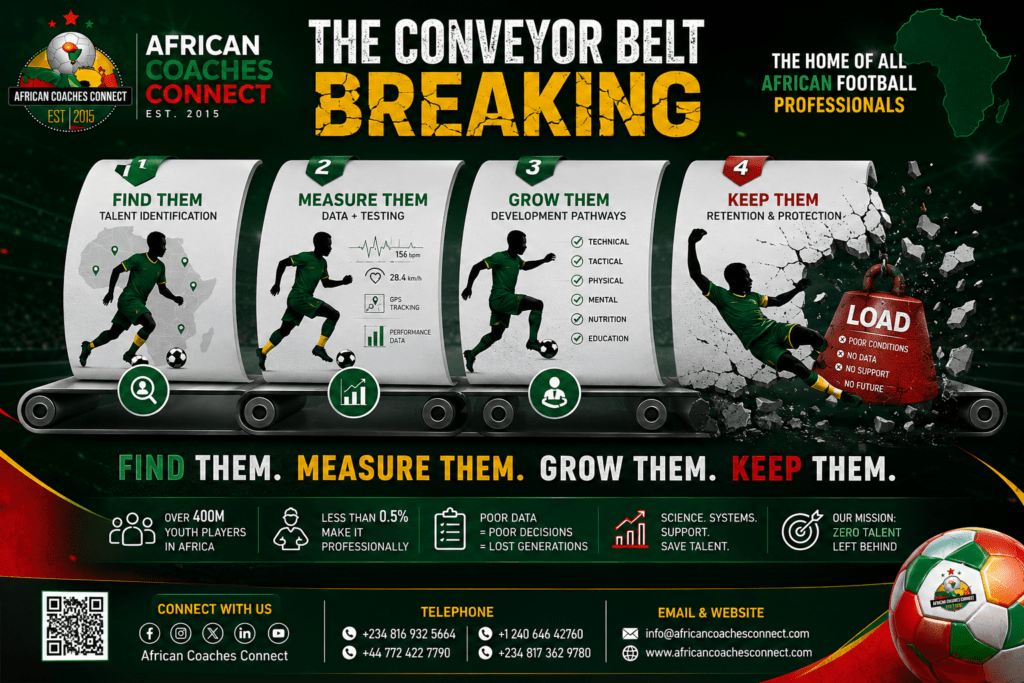
CONCLUSION: COMPLETING THE CONVEYOR BELT Paper 1: Find them. Paper 2: Measure them. Paper 3: Don’t cut them. Paper 4: Don’t break them. The Load Gap is the last leak. If 54 nations adopt ALMS, ACC projects: -40% to 50% reduction in youth time-loss injuries, +30% to 40% increase in players transitioning to pro football within 5 years. “We spent 3 papers learning how to grow talent. This paper is about learning how to keep it alive.”
Thank You – 2026 CAF. Medical Reports & Injury Surveillance 2019-2024 UEFA. Elite Club Injury Study 2022-2023 Season FIFA. Talent Development Report 2023; Injury Surveillance in Youth Football Gabbett TJ. The training-injury prevention paradox. Br J Sports Med. 2016;50:273-280. Malina RM, et al. Growth and maturity status of youth soccer players. J Sports Sci. 2015;33:1316-1325. UEFA. Youth Physical Performance Report 2024.
SHARE NOTE: PLEASE JOIN US TO AMPLIFY THE CONVERSATION. ELEVATE THE STANDARD. RAISE AFRICAN FOOTBALL.
If this challenged how you see the game, then it’s your duty to circulate it.
Great football nations are not built on passion alone. They are built on literacy — tactical, technical, and regulatory.
Share this note. Let’s move African football from noise to knowledge.
ACC | Building Intelligent Football
Eldred SUNJU-ABBEY “D’ SERVANT”, Convener, African Football Convention (AFC), Founder & President of Africa Coaches Connect (ACC) – Architect, Engineer and Solutionist of Africa’s Football Renaissance. Championing the Excellence, Autonomy and Actualization of African Football. Developing Africans through football, and developing football through Africans.