
By: Shittu Daniella Ayomiposi
For: African Coaches Connect – ACC
How Tactical Growth and Emerging Teams Challenged Africa’s Established Football Order
The 2026 Women’s Africa Cup of Nations in Morocco delivered more than a first-ever title for Cameroon. It exposed a changing competitive landscape in African women’s football.
The 16-team format created room for new stories. Malawi reached the final on their debut. Algeria finished with bronze. Côte d’Ivoire impressed during the group stage, while established sides including Nigeria, Zambia and hosts Morocco fell short of the final.
More importantly, these results revealed a growing influence of tactical organisation, adaptability and preparation.
- Malawi: The Power of a Clear Game Model
Malawi’s 3–2 victory over Nigeria immediately announced their intentions. Rather than trying to match Nigeria purely through individual quality, they made their strengths count through quick transitions, vertical attacking and intelligent exploitation of space.
Temwa Chawinga finished the competition with five goals and two assists, recording seven goal involvements.
But the bigger lesson is structural.
Can Malawi turn this breakthrough into consistency?
The answer will depend on what happens beyond the national team. Better youth pathways, stronger domestic competition and continuous coach development are necessary if this success is to become sustainable.
- Algeria and Côte d’Ivoire: Emerging Teams Are Learning to Compete
Algeria’s progression to the semi-finals showed how defensive discipline and efficient decision-making can carry an emerging side deep into a major tournament.
Their 2–1 victory over Côte d’Ivoire in the quarter-final was particularly telling. Côte d’Ivoire had already demonstrated considerable attacking strength, yet Algeria found a way to disrupt their rhythm and make the important moments count.
Côte d’Ivoire’s own campaign should not be overlooked. Their strong group-stage performance reflected the increasing tactical development of teams outside Africa’s traditional elite.
The challenge now is progression.
Emerging teams must develop both sides of the game: the defensive structure to remain competitive and the attacking mechanisms to consistently unlock organised opponents.
- Nigeria: When Individual Quality Meets a Tactical Wall
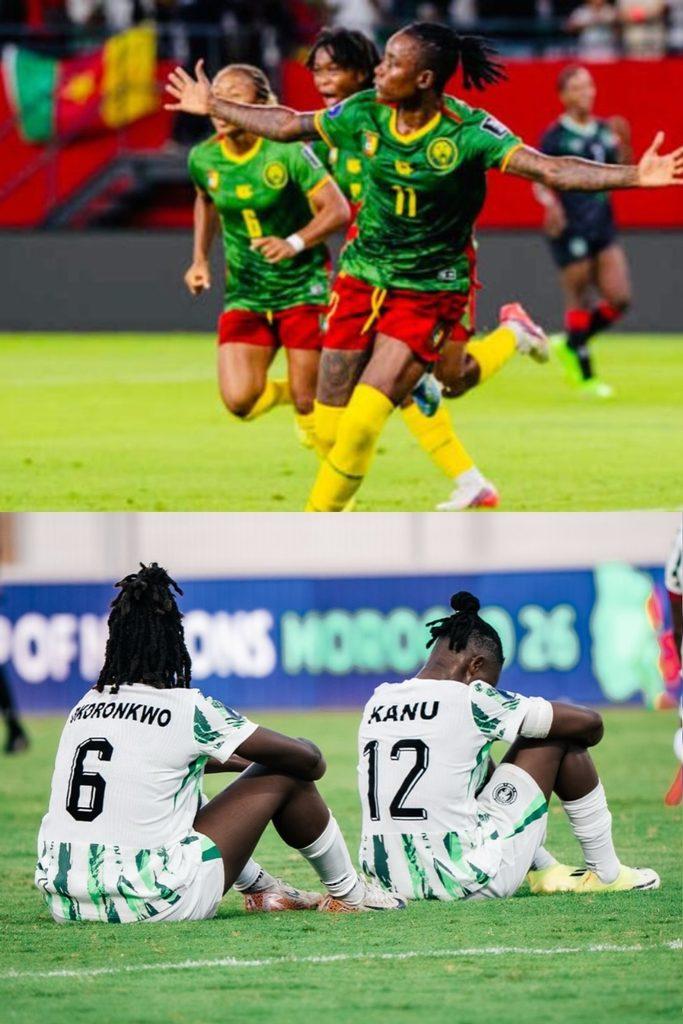
Nigeria’s quarter-final defeat to Cameroon offered one of the tournament’s clearest coaching lessons.
Cameroon took the lead from a set piece and then managed the game effectively, maintaining defensive discipline while goalkeeper Michaely Bihina played an important role.
For Nigeria, the issue was not a lack of talent. The bigger concern was finding enough variation to dismantle a disciplined defensive setup.
Possession only becomes valuable when it produces penetration.
Coaches must therefore develop different routes to goal: movement between lines, positional rotations, use of width, combinations around the penalty area and coordinated off-ball runs.
When an opponent closes one route, a top team needs another.
- Cameroon: Tactical Flexibility at Championship Level
Cameroon’s journey demonstrated the importance of adapting rather than forcing one approach throughout a tournament.
They absorbed pressure against Nigeria, negotiated a difficult contest with Morocco and then produced a far more aggressive attacking performance against Malawi in the final.
The 3–0 victory, powered by Marie Ngah Manga’s two goals, secured Cameroon’s first WAFCON championship.
Their success offers a valuable question for African coaches:
Does your team have one identity, or does it have enough tactical flexibility to respond to different opponents?
The best teams need both. A strong footballing identity should provide a foundation, not become a tactical limitation.
- Morocco and Zambia: Talent Still Needs a Framework
Morocco entered as hosts, while Zambia possessed some of the continent’s most dangerous attacking players. Yet neither reached the final.
That should not erase their quality. Instead, it highlights an important coaching principle: talent produces possibilities; structure converts those possibilities into results.
For Morocco, territorial control needed to produce more decisive attacking moments. For Zambia, individual attacking threats needed to be consistently integrated into a collective game plan.
The solution lies in more opponent-specific preparation, tactical analysis and training players to make better decisions under different match conditions.
- THE ACC COACHING LENS: Turning Progress Into a System
WAFCON 2026 leaves African coaches with three major priorities:
Build tactical identities.
Emerging teams such as Malawi and Algeria showed that a well-defined game model can narrow the gap with traditional powers.
Train adaptability.
Players should practise different scenarios breaking defensive blocks, protecting leads, responding to pressure and attacking transitions rather than preparing for only one style of play.
Invest beyond the tournament.
Breakthrough performances must be supported by stronger women’s leagues, youth development, coach education, performance analysis and long-term technical planning.
Conclusion: The Competitive Gap Is Changing
WAFCON 2026 showed that African women’s football is entering a more competitive era.
The biggest lesson is not simply that Cameroon won or that Malawi reached the final. It is that more African teams are developing the tactical tools to challenge established powers.
For coaches, that creates both an opportunity and a responsibility.
The next step is to ensure that these breakthroughs are not temporary. They must become part of stronger football structures capable of producing competitive teams year after year.
The underdogs have shown that the gap can be closed. Now African coaching must find ways to keep it closed.